Anemia YLDs Module
1.0 Overview
This document is the page for the anemia YLDs module of the MNCNH Portfolio simulation. The anemia module will process information related to simulants’ hemoglobin exposure throughout the course of the simulation and calculate corresponding anemia exposure and YLDs.
Note that the simulation implementation of anemia YLDs as it relates to the hemoglobin exposure modules has been performed slightly differently than written on these pages. The implementation strategy can be summarized as follows:
In order to keep a single definition of hemoglobin exposure throughout entire sim (as opposed to separate measures such as “hemoglobin at the start of pregnancy” and “hemoglobin at the end of pregnancy” as documented), we have multiple hemoglobin-related timesteps and update hemoglobin exposure and assess anemia YLDs across those timesteps rather than assess anemia YLDs as a lump sum from different hemoglobin values at different timepoints. Anemia YLDs are estimated according to the following steps:
Initialize anemia YLDs at 0.
Progress to the first trimester ANC visit hemoglobin timestep.
For simulants who attend that visit, update their anemia YLD values according to their hemoglobin exposure going into the visit and a duration equal to the gestational timing of their first trimester ANC visit (as defined in the parameter table on this document)
Update hemoglobin and LBWSG exposures according to interventions received at that visit
For simulants who do not attend that visit, do not update their anemia YLDs.
Progress to the later pregnancy ANC visit hemoglobin timestep.
For simulants who attend that visit and attended the first trimester visit as well, update their anemia YLD values according to their hemoglobin exposure going into that visit (intervention modified if covered) and the duration equal to the gestational timing of their later pregnancy visit minus the gestational timing of their first trimester visit (as defined in the parameter table on this document).
Update hemoglobin and LBWSG exposures according to interventions received at that visit
For simulants who attend that visit but not the first trimester visit update their anemia YLD values according to their hemoglobin exposure going into the visit (not intervention modified, even if covered at the later pregnancy visit) and a duration equal to the gestational timing of their later pregnancy ANC visit (as defined in the parameter table on this document)
Update hemoglobin and LBWSG exposures according to interventions received at that visit
For simulants who do not attend that visit, do not update their anemia YLDs
Progress to the end of pregnancy hemoglobin timestep
Update anemia YLDs according to hemoglobin exposure going into this timestep and the simulant-specific gestational time elapsed since the last time anemia YLDs were updated
Pregnancy duration for those who never attended any ANC visits
Pregnancy duration (according to intervention-modified gestational age) - gestational timing of later pregnancy ANC visit for those who attended later pregnancy ANC
Pregnancy duration (according to intervention-modified gestational age) - gestational timing of first trimester ANC visit for those who attended the first trimester but not later pregnancy ANC visit
Progress to the six weeks after the end of pregnancy hemoglobin timestep
For simulants who survived labor and progressed to the postpartum period, update their anemia YLD values according to their hemoglobin exposure during the first six weeks after pregnancy and a duration of six weeks (in years)
For simulants who did not survive labor and therefore do not progress to the postpartum period, do not update their anemia YLDs given that they should not experience any YLDs in the post-pregnancy timesteps
Progress to the nine months after the end of pregnancy hemoglobin timestep
For simulants who survived labor and progressed to the postpartum period, update their anemia YLD values according to their hemoglobin exposure between six weeks and nine months after pregnancy and a duration of 40 - 6 = 34 weeks (in years)
For simulants who did not survive labor and therefore do not progress to the postpartum period, do not update their anemia YLDs given that they should not experience any YLDs in the post-pregnancy timesteps
2.0 Module Diagram and Data
2.1 Module Diagram
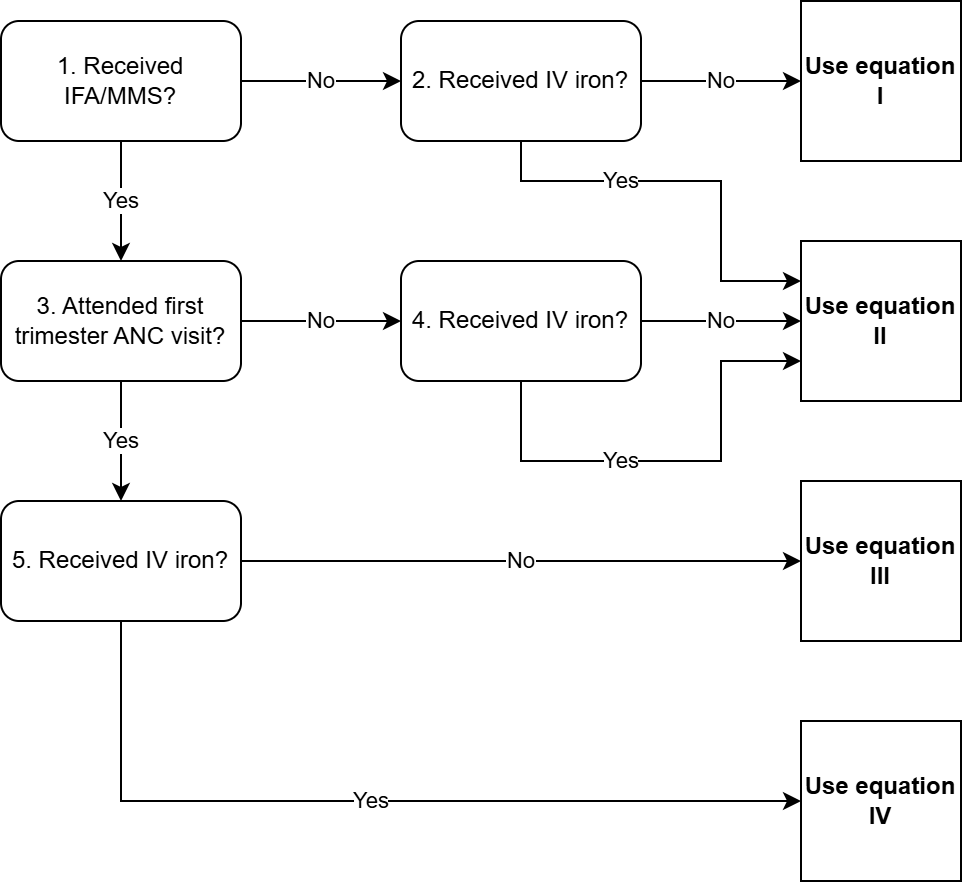
2.2 Module Inputs
Input |
Source module |
Application |
Note |
|---|---|---|---|
First trimester ANC attendance |
Determines anemia YLD calculation equation |
||
Hemoglobin at the start of pregnancy |
Used to calculate anemia YLDs |
||
Hemoglobin at end of pregnancy |
Used to calculate anemia YLDs |
||
Hemoglobin during the first six weeks after the end of pregnancy |
Used to calculate anemia YLDs |
Note that this value will be missing for simulants who did not survive labor |
|
Hemoglobin between six weeks and nine months after the end of pregnancy |
Used to calculate anemia YLDs |
Note that this value will be missing for simulants who did not survive labor |
|
IV iron coverage |
Determines anemia YLD calculation equation |
||
IFA/MMS coverage |
Determines anemia YLD calculation equation |
||
Pregnancy duration |
Used to calculate anemia YLDs |
2.3 Module Decision Nodes
Decision node |
Description |
Information |
Note |
|---|---|---|---|
1 |
Received IFA/MMS? |
Yes if IFA/MMS coverage input value == True |
|
2, 4, 5 |
Received IV iron |
Yes if IV iron coverage input value == True |
|
3 |
Attended first trimester ANC visit |
Yes if first trimester ANC attendance input value == True |
2.4 Module Action Points
We assume that hemoglobin may vary throughout the course of pregnancy/postpartum at the following distinct points opportunities: (1) following IFA/MMS supplementation at the first trimester ANC visit, (2) following IFA/MMS supplementation or IV iron administration at the later pregnancy ANC visit, and (3) following an incident case of maternal hemorrhage during labor, and (4) six weeks after the end of pregnancy when the simulant is no longer “physiologically pregnant.” Therefore, we will calculate YLDs due to anemia during pregnancy in this model as a weighted sum over the course of pregnancy stratified by these specified events.
Note that simulants who died during labor should not experience any YLDs due to anemia in the post-pregnancy timesteps. In other words, \(\text{DW}_\text{preg}(\text{hgb}^\text{6w}_i) * \text{duration}^\text{6w} = \text{DW}(\text{hgb}^\text{9m}_i) * \text{duration}^\text{9m} = 0\) for these simulants.
Equation |
Value |
Note |
|---|---|---|
I |
\(\text{DW}_\text{preg}(\text{hgb}^\text{start}_i) * \text{duration}^\text{preg}_i + \text{DW}_\text{preg}(\text{hgb}^\text{6w}_i) * \text{duration}^\text{6w} + \text{DW}(\text{hgb}^\text{9m}_i) * \text{duration}^\text{9m}\) |
No interventions in pregnancy |
II |
\(\text{DW}_\text{preg}(\text{hgb}^\text{start}_i) * T^\text{first trimester}_i + \text{DW}_\text{preg}(\text{hgb}^\text{birth}_i) * (\text{duration}^\text{preg}_i - T^\text{first trimester}_i) + \text{DW}_\text{preg}(\text{hgb}^\text{6w}_i) * \text{duration}^\text{6w} + \text{DW}(\text{hgb}^\text{9m}_i) * \text{duration}^\text{9m}\) |
Received IFA/MMS and/or IV iron at later pregnancy visit |
III |
\(\text{DW}_\text{preg}(\text{hgb}^\text{start}_i) * T^\text{later pregnancy}_i + \text{DW}_\text{preg}(\text{hgb}^\text{birth}_i) * (\text{duration}^\text{preg}_i - T^\text{later pregnancy}_i) + \text{DW}_\text{preg}(\text{hgb}^\text{6w}_i) * \text{duration}^\text{6w} + \text{DW}(\text{hgb}^\text{9m}_i) * \text{duration}^\text{9m}\) |
Received IFA/MMS at first trimester visit, no IV iron |
IV |
\(\text{DW}_\text{preg}(\text{hgb}^\text{start}_i) * T^\text{first trimester}_i + \text{DW}_\text{preg}(\text{hgb}^\text{start}_i + \text{shift}^\text{IFA/MMS}) * (T^\text{later pregnancy}_i - T^\text{first trimester}_i) + \text{DW}_\text{preg}(\text{hgb}^\text{birth}_i) * (\text{duration}^\text{preg}_i - T^\text{later pregnancy}_i) + \text{DW}_\text{preg}(\text{hgb}^\text{6w}_i) * \text{duration}^\text{6w} + \text{DW}(\text{hgb}^\text{9m}_i) * \text{duration}^\text{9m}\) |
Received IFA/MMS at first trimester visit, IV iron at later pregnancy visit |
Parameter |
Value |
Source/Note |
|---|---|---|
\(\text{DW}_\text{preg}(\text{hgb})\) |
Function that returns the anemia disability weight for a given hemoglobin level during pregnancy. Note that as written this function will need to be able to handle simulants who have died in the intrapartum component and did not progress to the postpartum period (i.e. return zero for these simulants) |
See the anemia impairment document for anemia hemoglobin thresholds (use the pregnancy-specific values) and disability weights |
\(\text{DW}(\text{hgb})\) |
Function that returns the anemia disability weight for a given hemoglobin level not during pregnancy. Note that as written this function will need to be able to handle simulants who have died in the intrapartum component and did not progress to the postpartum period (i.e. return zero for these simulants) |
See the anemia impairment document for anemia hemoglobin thresholds (use the non-pregnancy-specific values) and disability weights |
\(\text{hgb}^\text{start}_i\) |
Hemoglobin exposure at the start of pregnancy for individual simulant |
|
\(\text{hgb}^\text{birth}_i\) |
Hemoglobin exposure at birth for individual simulant |
|
\(\text{hgb}^\text{6w}_i\) |
Hemoglobin during first six weeks after end of pregnancy for individual simulant |
Postpartum hemoglobin module. Note that there are some simulants who will not survive to the postpartum period and will have undefined postpartum hemoglobin. |
\(\text{hgb}^\text{9m}_i\) |
Hemoglobin during the period from 6 weeks to 9 months after the end of pregnancy for individual simulant |
Postpartum hemoglobin module. Note that there are some simulants who will not survive to the postpartum period and will have undefined postpartum hemoglobin. |
\(\text{duration}^\text{preg}_i\) |
Pregnancy duration in years for individual simulant |
Pregnancy II module, note a unit conversion to years may be necessary |
\(\text{duration}_\text{6w}\) |
6 * 7 / 365.25 |
|
\(\text{duration}_\text{9m}\) |
34 * 7 / 365.25 |
|
\(\text{shift}_\text{IFA/MMS}\) |
Effect of IFA/MMS on hemoglobin |
|
\(T^\text{first trimester}_i\) |
Randomly sample a different value for each simulant who attends a first trimester ANC visit. Use the distribution corresponding to the simulant’s assigned pregnancy duration (based on gestational age at birth exposure before it has been modified by interventions as a modeling convenience):
|
Note that we define minimum pregnancy duration/gestational age at birth values of 20 weeks for live births, 24 weeks for stillbirths, and 6 weeks for abortion/miscarriage/ectopic pregnancies (see details on the pregnancy model document) |
\(T^\text{later pregnancy}_i\) |
Randomly sample a different value for each simulant who attends the later pregnancy ANC visit from a uniform distribution between 12/52 and \(\text{duration}^\text{pregnancy}_i - 2/52\). Note that pregnancy duration used in this context will be affected by interventions received at the first trimester visit and unaffected by interventions received at the later pregnancy visit as a modeling convenience. |
Note that abortion/miscarriage/ectopic pregnancies cannot attend later pregnancy ANC visits according to the ANC attendance module. The minimum gestational age at birth for the remaining relevant pregnancy outcomes is 20 weeks for live births and 24 weeks for stillbirth, so we will not encounter later pregnancy ANC attendance among pregnancies that end prior to 14 weeks of gestation, which would result in a negative value. |
pregnancy duration |
Duration of pregnancy for a given simulant, output from the pregnancy module |
Pregnancy duration is equal to gestational age at birth for live and stillbirths. Note that pregnancy duration as defined here should be intervention-modified. |
Note
Assumptions surrounding the timing of antenatal care visits as defined in the table above were informed by the following:
In the U.S., pregnancy providers generally don’t book first ANC visits until 8 weeks of gestation, which earliest time when pregnancy can be reliably confirmed as intrauterine/vitals assessed via ultrasound, unless there are concerning symptoms before then. Papers such as [Endawkie-et-al-2024] show pretty low rates of first ANC visit prior to 8 weeks for our modeled locations. Since the minimum pregnancy duration in our model for ectopic/abortion/miscarriage pregnancies is 6 weeks (see the pregnancy model document), we needed to allow for first trimester ANC visits as early as 6 weeks to avoid assigning first trimester ANC visit attendance after a pregnancy has ended among this group. Therefore, we assume that the ectopic/abortion/miscarriage pregnancies in our model represent the small portion of pregnancies with early concerning symptoms that attend ANC visits prior to 8 weeks and assume all other pregnancies do not attend ANC prior to 8 weeks of gestation.
Note that we assume the later pregnancy ANC visit occurs at least two weeks prior to the end of pregnancy. This was an arbitrary decision to avoid administration of IV iron very close to the onset of the intrapartum period.
2.4: Module Outputs
Output |
Value |
Dependencies |
|---|---|---|
Anemia YLDs |
Point value |
Simulation result |
3.0 Assumptions and limitations
We assume uniform distribution across assumed plausible ranges for timing of ANC visits as well as timing of pregnancies that end in ectopic pregnancy/miscarriage/abortion (as detailed on the pregnancy model document) rather than informing these parameters with data
We assume that interventions affect anemia YLDs at the time of administration at ANC (as according to the timed assumptions in the two prior bullets) with no additional delay
We do not model any deaths in the 9 months after pregnancy, so we assume that all simulants who survive labor also survive 9 months afterward and therefore experience anemia YLDs during this period. This may lead to a slight overestimation of anemia YLDs.
We do not model simulants changing age groups during the 9 months after pregnancy, and thereby slightly underestimate the ages of people in this period. The impact of this on anemia YLDs depends on how hemoglobin differs between a simulant’s age group and the next: if the next age group has higher hemoglobin, and the simulant would have aged into it, then we will underestimate anemia YLDs during this period, and if the next age group has lower hemoglobin, and the simulant would have aged into it, then we will overestimate anemia YLDs during this period. We expect this effect to be small, but it is unclear whether it will lead to an overall overestimation or underestimation of anemia YLDs.
We use the exposure value for gestational age at birth as an input to determining the timing of ANC visits in our simulation. Given that gestational age at birth exposures are affected by interventions and therefore are different between scenarios and also change across timesteps within scenarios as simulants gain access to different interventions, our model is limited in that there may be slightly different ANC visit timing for the same simulant in different scenarios. Additionally, there may be differences in the pregnancy duration value used to determine timing of an ANC visit and the final gestational age at birth exposure for a maternal/child dyad. Given that the ANC visit timing variable only affects anemia YLDs in our simulation (which is expected to be a small portion of overall impact), we have deemed this an acceptable limitation.
4.0 Verification and Validation Criteria
Baseline simulated anemia YLDs, excluding the six weeks to nine months after pregnancy timestep, should match corresponding pregnancy-specific GBD values. Run the following command to load the data from GBD 2023:
get_outputs(
    location_id=[165,179,214],
    topic='rei',
    rei_id=[206,206,207], # We also have rei_id=192 for all anemia and rei_id=432 for moderate and severe combined
    population_group_id=16,
    sex_id=2,
    year_id=2023,
    release_id=16, # release_id=33 also works
    compare_version_id=8306,
    measure_id=[3,5],
    age_group_id=[7, 8, 9, 10, 11, 12, 13, 14, 15, 24, 169]
)
Note
Make sure you have the latest version of db_queries to be able to use the population_group_id argument. To get pregnancy-specific results, the population group and the age groups need to be specified, because the default is all ages.
As of the time of writing (July 2025), we can only use population_group_id=16 with get_outputs(). There were a few EPIC/COMO runs with pregnancy this GBD round, which are noted in the tracking HUB page.
5.0 References
Endawkie A, Kebede SD, Abera KM, Abeje ET, Enyew EB, Daba C, Asmare L, Bayou FD, Arefaynie M, Mohammed A, Tareke AA, Keleb A, Kebede N, Tsega Y. Time to antenatal care booking and its predictors among pregnant women in East Africa: a Weibull gamma shared frailty model using a recent demographic and health survey. Front Glob Womens Health. 2024 Nov 27;5:1457350. doi: 10.3389/fgwh.2024.1457350. PMID: 39664654; PMCID: PMC11631944. https://pmc-ncbi-nlm-nih-gov.offcampus.lib.washington.edu/articles/PMC11631944/