Vivarium Gates Balanced Energy Protein
List of abbreviations |
|
|---|---|
LAZ |
Length-for-age Z-score |
WLZ |
Weight-for-length Z-score |
BEP |
Balanced energy protein |
IFA |
iron and folic acid |
MMN |
multi-nutrients including iron and folic acid |
oMMN |
multi-nutrients other than iron and folic acid |
CGF |
child-growth failure |
1.0 Background
Pregnancy is a period of increased energy demands from the women’s changing physiology and fetus’ growing requirements. Inadequate maternal nutrition or energy are common among women residing in low- and middle-income countries. Nutritional deficiencies can result in poor maternal and infant outcomes.
Iron and folic acid (IFA): Worldwide prevalence of iron deficiency anaemia in pregnancy is about 20%. Maternal anemia due to iron deficiency is associated with increased risk of maternal mortality, perinatal mortality and infants with low birth weight (LBW). Folic acid deficiency can lead to haematological consequences and congenital malformations; however, association with other birth outcomes is equivocal. WHO recommends iron and folic acid (IFA) supplementation for women during the antenatal period as part of routine antenatal care (ANC). The recommended dose of iron ranges from 30 mg to 60 mg. Despite its provision as part of national antenatal care programs for the last few decades in most low- and middle-income countries, coverage with the supplement is low.
Multi-micronutrients (MMN): Vitamin A deficiency is measured in night blindness and serum retinol levels. Globally, around 15% of pregnant women are deficient in vitamin A. Supplementation during pregnancy has been shown to reduce risk of maternal anaemia, infection and night blindness, but not on birth outcomes. Zinc deficiency has been associated with complications of pregnancy and delivery such as pre-eclampsia, premature rupture of membranes and congenital abnormalities. However, a review of trials of zinc supplementation showed a reduction in pre-term births only (other nutrients not reviewed here as they are not GBD risk factors). There is some evidence of additional benefit of a MMN supplements containing 13–15 different micronutrients (including iron and folic acid) over iron and folic acid supplements alone, but there is also some evidence of risk, and some important gaps in the evidence. As such, WHO does not currently recommend a multi-nutrient supplement for pregnant women to improve maternal and perinatal outcomes.
Balanced energy protein (BEP): Under-nourished women are negatively associated with fetal growth and have increased risk of preterm birth. Balanced protein (where protein content provides less than 25% of total energy content) supplementation during pregnancy may help with gestational weight gain and subsequently avert adverse pregnancy outcomes, but the benefits are unclear. WHO recommends BEP for populations or settings with a high prevalence of undernourished pregnant women (not for individual pregnant women identified as being undernourished) to reduce the risk of stillbirths and small for-gestational-age neonates. Undernourishment is usually defined by a low BMI (i.e. being underweight BMI<18.5). For adults, a 20–39% prevalence of underweight women is considered a high prevalence of underweight and 40% or higher is considered a very high prevalence. MUAC may also be useful to identify protein–energy malnutrition in individual pregnant women and to determine its prevalence in this population. However, the optimal cut-off points may need to be determined for individual countries based on context-specific cost–benefit analyses.
1.1 Project overview
There is belief that benefits of BEP supplementation are currently underestimated and that targeting individual pregnant women with low BMI may be more cost beneficial. There are currently on-going Gates funded clinical trials evaluating the impact of BEP in India, Pakistan, Mali and Tanzania. This simulation project aims to estimate the cost benefits of universal or targeted offer of BEP if the anticipated improvement in infant outcomes are achieved.
1.2 Literature review
2.0 Modeling aims and objectives
To understand the cost-effectiveness of BEP and MMN supplementation for pregnant and lactating women (PLW) on child health outcomes. We will consider the costs and DALYs of baseline, and a range of scenarios.
Objective 1: Comparing the cost-effectiveness of IFA, MMN, and BEP (targeted and universal) interventions using current evidence available.
Objective 2: Comparing the cost-effectiveness of BEP (targeted and universal) interventions using hypothetical hope-n-dreams effect for BEP.
Important
note that there is now a set of current evidence scenarios (objective 1). Objective 2 (hopes-n-dreams) were the scenarios we modelled in our feb_2020 model using Gates provided aspirational effect sizes.
3.0 Causal framework
3.1 Causal diagram

Outcome (O):
birthweight in grams
LAZ score
WLZ score
Effect modifiers:
The effect of BEP on birthweight is differential according to maternal BMI
Objective 1: current evidence scenarios
Under the current evidence scenarios, the intervention BEP affects only birthweight. It does so differentially by maternal BMI status (Ota 2015). BMI is an effect modifier on the relationship between BEP and birthweight.
Note
BMI should have an effect on LAZ and WLZ scores suggested by the literature (and Gates) but we are not intervening on BMI, and so simply correlating birthweight and LAZ / WLZ will capture the relationship between BMI and LAZ/WLZ.
note x represents a crude effect size because we are not intervening on BMI and we only use this effect in baseline. (ideally crude mean shift birthweight by maternal BMI)
Originally Gates wanted us to model an effect size of RR=2 for BMI on LAZ and WLZ scores, which we did in our februrary model. However, since we are not intervening on BMI, we do not need to model this causal effect. We only want the baseline LAZ and WLZ scores by BMI status and this relationship should be captured by the correlation co-efficient between birthweight and LAZ and WLZ score.
BEP only affects pregnancy weight-gain (given during pregnancy at ANC) and not pre-pregnancy BMI, hence no causal arrow from BEP to BMI (pre-pregnancy).
Objective 2: hopes-n-dreams scenarios
Current evidence does not show an effect between BEP and LAZ or WLZ scores (Ota 2015 Cochrane review). But there is reason to believe it should affect child growth and hence we are modelling this effect in the hopes-n-dreams objective.
There is also reason to believe that the effect of BEP on malnourished and normal women should be higher than reported in the trials from Ota 2015. Hence, and a bigger effect size for both subgroups is also modelled in objective 2 (+75g for normal and +100g for malnourished).
These are the effects that Gates hope to see in their current trials.
Note
- Potential reasons why current literature may not capture the effect of BEP on WLZ/LAZ
o While the literature has strong evidence there is some causal effect size between birthweight LAZ n WLZ (Harding 2017), the effect from BEP through birthweight might not be big enough to show an effect in LAZ or WLZ through birthweight or the studies might not be powerful enough to detect a difference. o Following up to child-growth failure outcomes require a long follow-up period, hence this outcome might not be measured accurately in current studies.
Here is a memo describing the rationale underlying the causal structure of this model: causal_dag_memo.docx
3.2 Effect sizes
Effect |
Description |
Current evidence |
Source |
Hopes and dreams |
Source |
|---|---|---|---|---|---|
a (∆IFA) |
IFA vs no IFA or placebo on birthweight in g |
+57.73 g (7.66 to 107.79) |
Pena 2015 Cochrane review |
same |
same |
b (∆oMMN) |
MMN vs IFA on birthweight in g |
+45.16 (32.31 to 58.02) random effects |
meta analysis of 13 trials from Keats 2019 |
same |
same |
d1 and d’1 (∆BEP_mal) |
BEP vs control (we interpret this as MMS) on birthweight in g among malnourished BMI women |
+66.96g (13.13 to 120.78) for d1 |
Ota 2015 Cochrane review |
+100g (±10) for d’1 |
TPP target/potentially Ceesay et al 1997 BMJ |
d and d’0 (∆BEP_norm) |
BEP vs control (we interpret this as MMS) on birthweight in g among adequately nourished BMI women |
+15.93 (-20.83 to 52.69) for d0 |
Ota 2015 Cochrane review |
+15.93 (-20.83 to 52.69) for d’0 |
Ota 2015 Cochrane review |
x |
crude birthweight in g shift between low and normal BMI women |
-147.71 (-210.9 to -84.52) random effects |
meta analysis of 9 studies |
same |
same |
f (WE NO LONGER USE f) |
effect size of BMI on CGF (laz and wlz) |
none (although we will validate with correlation literature) |
Source |
RR = 2(1.5-5) |
Gates, informed by Zhou Br Nutr J 2019, Misra Med J Armed Forces India 2015; Yang Plos One 2015, Model assumption |
E_laz |
BEP vs. control/no intervention on LAZ score at 6 months |
none |
none |
+0.3 (±0.1) |
TPP target/ Kusin et.al 1992 Lancet |
E_wlz |
BEP vs. control/no intervention on WLZ score at 6 months |
none |
none |
+0.3 (±0.1) |
TPP target/ Kusin et.al 1992 Lancet |
c_laz |
Spearman correlation co-efficient for birthweight and LAZ |
0.394 (0.353 to 0.433; sd = 0.020) |
MAL-ED study |
same |
same |
c_wlz |
Spearman correlation co-efficient for birthweight and WLZ |
0.308 (0.263 to 0.351; sd = 0.022) |
MAL-ED study |
same |
same |
Note
use random effect values
Important
b: also note that I have updated the effect size of ∆oMMN
d1 and d0: added effect size of BEP for current-evidence scenario (∆BEP_norm and ∆BEP_mal)
x: updated effect of BMI on birthweight to a continuous shift rather than back-calculating a shift using an RR of 2(1.5-5)
use random effects for x
In this model, there are three ‘entities’ that affect child outcomes:
iron and folic acid,
multi-micronutrients and vitamins other than iron and folic acid, and
protein and extra caloric energy.
Each of these entities produce a ∆effect size as follows:
∆IFA: effect of iron and folic acid supplementation vs. no iron no folic acid or placebo
Dombined pill or separate pill (30-60 mg iron, 400 μg folic acid) given as soon as possible during pregnancy
Infant outcomes affected: increases birthweight(g)
∆ oMMN: other multi-micro nutrient supplementation vs. iron and folic acid
Multiple micronutrients supplementation is defined as supplementation with at least 5 micronutrients including the UNIMMAP formulation: 2 mg copper, 65 μg selenium, 800 μg RE vitamin A, 1.4 mg vitamin B1, 1.4 mg vitamin B2, 18 mg niacin, 1.9 mg vitamin B6, 2.6 μg vitamin B12, 70 mg vitamin C, 5 μg vitamin D, 10 mg vitamin E and 150 μg iodine, 30 mg iron, 400 μg folic acid, 15 mg zinc
Infant outcomes affected: reduces preterm births (<37 weeks)-CIs slightly spans 1, reduces low birth weight, increases birthweight(g), reduces small-for gestational age
Note
The intervention MMN inherently contains IFA. The trials looking at the effect size of MMN compares the intervention groups (MMN) with an IFA supplemented control groups. Hence the effect size we use coming out of these trials give us ∆ oMMN, the effect of those other minerals and vitamins.
∆ BEP_mal and ∆ BEP_norm: balanced energy protein supplementation vs. control or placebo
These are supplements in which protein provides less than 25% of the total energy content
The trials investigating the effect size of BEP starts supplementing anywhere between first trimester to third trimester.
Infant outcomes affected: increases birthweight(g), reduces small for gestational age
Note
The trials from Ota 2015 Cochrane review report no standard forumla for BEP. BEP can come in the form of a pre-fabricated nutrient bar/goo/drink that contains calories, proteins, and fat, and additionally may contain minerals or vitamins OR it can be food vouchers for milk, oil, nuts. The intervention vs control groups from these trials give us the added benefit of energy + protein only see memo. Hence, the ∆ BEP_mal and ∆ BEP_norm coming from these trials refers to the effect of energy and protein only.
4.0 Intervention
We have three tiers of interventions and we assume the effects are additive:
Basic: iron and folic acid only
this is present in the basline.
Women recieve a ∆IFA effect if they are covered
Basic+ (iron and folic acid + other multi-micronutrients)
This is not present in baseline and only in the scenarios
women who are covered by basic+ recieve ∆IFA & ∆oMMN
Basic++ (iron and folic acid + other multi-micronutrients + energy and protein)
this is also not present in baseline and only in the scenarios
women who are covered by basic++ recieve ∆IFA & ∆oMMN & [∆BEP_mal | ∆BEP_norm]
4.1 Simulation scenarios
Scenario A (baseline): Offering basic (IFA) to any women attending ANC at empirical baseline coverage of IFA at ANC.
among the general population: this is the % who attends ANC x % of IFA coverage at ANC
Scenario B: Offering basic+ (IFA + oMMN) to any women attending ANC at 90% coverage at ANC.
Those who receive basic+ among the general population = % who attends ANC x 90% coverge at ANC
Scenario C: Offering basic++ (IFA + oMMN + BEP_universal), using current-evidence effect size for BEP, to 90% of women attending ANC.
Those who receive basic++ among the general population = % who attends ANC x 90% coverage at ANC
Scenario D: Offering basic++ (IFA + oMMN + BEP_targeted), using current-evidence effect size for BEP, to 90% of undernourished women attending ANC, and basic+ (IFA + MMN) to 90% of normal BMI women attending ANC.
Those who receive basic++ among the general population = % who attends ANC x 90% coverage at ANC X % undernourished population
Those who receive basic+ among the general population = % who attends ANC x 90% coverage at ANC X % normal population
Scenario E: Offering basic++ (IFA + oMMN + BEP_universal), using hopes-and-dreams effect size for BEP, to any women attending ANC at 90% coverage at ANC.
Those who receive basic++ among the general population = % who attends ANC x 90% coverage at ANC
Scenario F: Offering basic++(IFA + MMN + BEP_targeted), using hopes-and-dreams effect size for BEP, to 90% of undernourished women attending ANC, and basic+ (IFA + oMMN) to 90% of normal BMI women attending ANC.
Those who receive basic++ among the general population = % who attends ANC x 90% coverage at ANC X % undernourished population
Those who receive basic+ among the general population = % who attends ANC x 90% coverage at ANC X % normal population

Important
note there are now scenarios C and D which uses current-evidence effect sizes for BEP_targeted
5.0 Vivarium modelling components
5.1 Vivarium concept model

Green arrow indicates target effect sizes given by Gates TPP targets; dotted arrows indicate a correlation
5.2 Demographics
Population: closed prospective cohort of infants born from birth to 2-years old
Exclusion criteria: None
Start and end year: 2020-2022
Simulation time step: 1 day
Location: India, Pakistan, Mali, Tanzania
Size of largest starting population: Number of live births
Youngest start-age and oldest end age: 0-2 years
Fertility: none
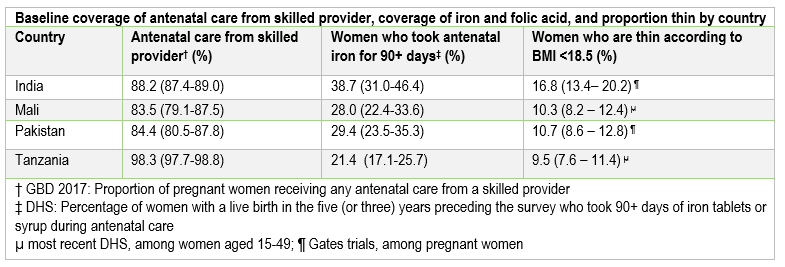
Other: % of women who are thin according to BMI at baseline
5.3 Models
5.3.1 model 1: Baseline (scenario A)
The baseline model contains a baseline coverage rate of IFA and a proportion of malnourished women. Both IFA and mother’s BMI status has an affect on birthweight. Hence we must calibrate the baseline model by IFA coverage and maternal BMI.
Notation:
bmi1 Babies born to malnourished mothers with low BMI (<18.5)bmi0 Babies born to normal mothers with BMI (>18.5)ifa1 Babies born to mothers who had IFA coverageifa0 Babies born to mothers without IFA coveragepop Baseline populationBW Birthweight
Calibrating birthweight to maternal BMI and IFA baseline coverage:
BW_bmi1_ifa1 (g): mean birthweight of babies born to low BMI mothers who had IFABW_bmi1_ifa0 (g): mean birthweight of babies born to low BMI mothers who did not have IFABW_bmi0_ifa1 (g): mean birthweight of babies born to normal BMI mothers who had IFABW_bmi0_ifa0 (g): mean birthweight of babies born to normal BMI mothers who did not have IFAM1: proportion of mothers with low BMI (<18.5)IFA1: IFA coverage in baseline populationEq. 1: BW_bmi1_ifa1 - BWbmi1_ifa0 = +57.73g(7.66 to 107.79) Birthweight(g) difference from IFA vs nothingEq. 2: BW_bmi0_ifa1 - BWbmi0_ifa0 = +57.73g(7.66 to 107.79) Birthweight(g) difference from IFA vs nothingEq. 3: BW_bmi1_ifa0 - BWbmi0_ifa0 = -142.93g (-232.68 to -53.18) random effectsmemoEq. 4: M1 x IFA1 x (BW_bmi1_ifa1) + M1 x (1-IFA1) x (BW_bmi1_ifa0) + (1- M1) x IFA1 x BW_bmi0_ifa1 + (1- M1) x (1-IFA1) x BW_bmi0_ifa0 = BW_pop from GBD
To get the ∆BW shift to apply to the GBD population by simulant attribute group:
∆BW_bmi1_ifa1 = BW_pop - BW_bmi1_ifa1 (malnourished, covered by baseline IFA)∆BW_bmi1_ifa0 = BW_pop - BW_bmi1_ifa0 (malnourished, not covered by baseline IFA)∆BW_bmi0_ifa1 = BW_pop - BW_bmi0_ifa1 (normal, covered by baseline IFA)∆BW_bmi0_ifa0 = BW_pop - BW_bmi0_ifa0 (normal, not covered by baseline IFA)
Maternal BMI and stunting
Women with low BMI have higher risk for stunting
LAZ_bmi1: mean LAZ score of babies born to low BMI mothers at 6 monthsLAZ_bmi0: mean LAZ score of babies born to normal BMI mothers at 6 monthsM1: proportion of mothers with low BMI (<18.5)Eq. 1: LAZ_bmi1 - LAZ_bmi0 = shift in LAZ score corresponding to a RR of 2(1.5-5)Eq. 2: LAZ_bmi1 x M1 + LAZ_bmi0 x (1- M1) = LAZ_pop from GBD∆LAZ_bmi1 = LAZ_pop - LAZ_bmi1∆LAZ_bmi0 = LAZ_pop - LAZ_bmi0
Method for how to calculate the shift in LAZ score from a risk ratio not shown
Maternal BMI and wasting
Women with low BMI have higher risk for wasting
WLZ_bmi1: mean WLZ score of babies born to low BMI mothers at 6 monthsWLZ_bmi0: mean WLZ score of babies born to normal BMI mothers at 6 monthsM1: proportion of mothers with low BMI (<18.5)Eq. 1: WLZ_bmi1 - WLZ_bmi0 = shift in WLZ score corresponding to a RR of 2(1.5-5)Eq. 2: WLZ_bmi1 x M1 + WLZ_bmi0 x (1- M1) = WLZ_pop from GBD∆WLZ_bmi1 = WLZ_pop - LAZ_bmi1∆WLZ_bmi0 = WLZ_pop - LAZ_bmi0
Method for how to calculate the shift in WLZ score from a risk ratio not shown
5.3.2 model 2: Interventions
Apply the following intervention shifts according to interventions recieved in each of the scenarios A-F

5.4 Desired outputs
5.5 Output meta-table shell
*added cgf z-score outputs by timepoint 29 days and 366 days
5.6 Validation and verification
6.0 Back-of-envelope calculations
7.0 Limitations
8.0 Journal reviewer comments
Note
We have done a sensitivity analysis on coverage for MMS, universal BEP and targeted BEP for a series of coverage points using one draw to explore relationship between the coverage proportion of the interventions and outcome (DALY’s averted):
0.4, 0.45, 0.5, 0.55, 0.6, 0.65, 0.7, 0.75, 0.8, 0.85, 0.9
Results are located here /share/costeffectiveness/results/vivarium_gates_bep/sensitivity_analysis/
Todo
Determine why increasing coverage from 0.75 to 0.8 results in fewer DALYs averted for Tanzania in sensitivity analysis
For an updated run of the BEP simulation model for the repsonse to reviewers, we plan to include the following updates (for the full 100 simulation draws, all four locations, all scenarios):
1. updated hopes hopes-and-dreams effect size of BEP
Parameter |
Previous value |
Updated value |
Note |
BEP hopes and dreams effect size (g) |
+100 (point estimate) |
+136 (normal distribution with standard deviation of 29 g) |
Updated from assumption to value informed by Ceesay et al 1997 BMJ |
2. updated maternal undernourishment effect size on birthweight
Parameter |
Previous value |
Updated value |
Note |
Maternal low BMI shift in birthweight (g) |
-147.71 (95% CI: -210.9, -84.52) |
-138.46 (95% CI: -174.68, -102.25) |
Normal distribution of uncertainty |
3. sex stratification of outputs
4. updated intervention coverage targets
The updated intervention coverage targets should be implemented as three separate runs of the simulation and the results should be stratified by these targets in the same way that they were for the sensitivity analysis runs.
Intervention coverage level |
Value |
Note |
|---|---|---|
Low |
baseline IFA coverage / ANC proportion |
Location-specific. Should be calculated in simulation to be specific to draw-level values. Needs transformation to be specific to coverage among ANC attendees since baseline coverage is defined in terms of the general population. |
Medium |
0.6 |
For all locations |
High |
0.9 |
For all locations |
Note
Medium coverage level is a low priority and can be excluded to reduce computational load
5. SD calculation from confidence interval calculation should be (upper limit - lower limit)/2x1.96, and not 1.98.