Tiered Maternal Anemia Intervention
Abbreviation |
Definition |
|---|---|
BEP |
Balanced Energy Protein |
DFS |
Double Fortified Salt |
MMS |
Multiple Micronutrient Supplement |
IFA |
Iron-folic Acid |
ANC |
Antenatal Care |
BMI |
Body Mass Index |
PLW |
Pregnant and Lactating Women |
LMICs |
Low- and Middle-Income Countries |
Focal countries |
Pakistan, Bangladesh, Nigeria, Malawi |
Intervention Overview
Tiered maternal anemia intervention is an integrated life course intervention designed for at-risk female popualtion (e.g., women during pregnancy, women of reprodictive age, etc.) for averting the burden of maternal anemia in LMICs. It consists of three tiers: 1) Large-scale food fortificaiton (DFS), 2) Supplmentation (BEP and MMS), and 3) treatment (IV iron).
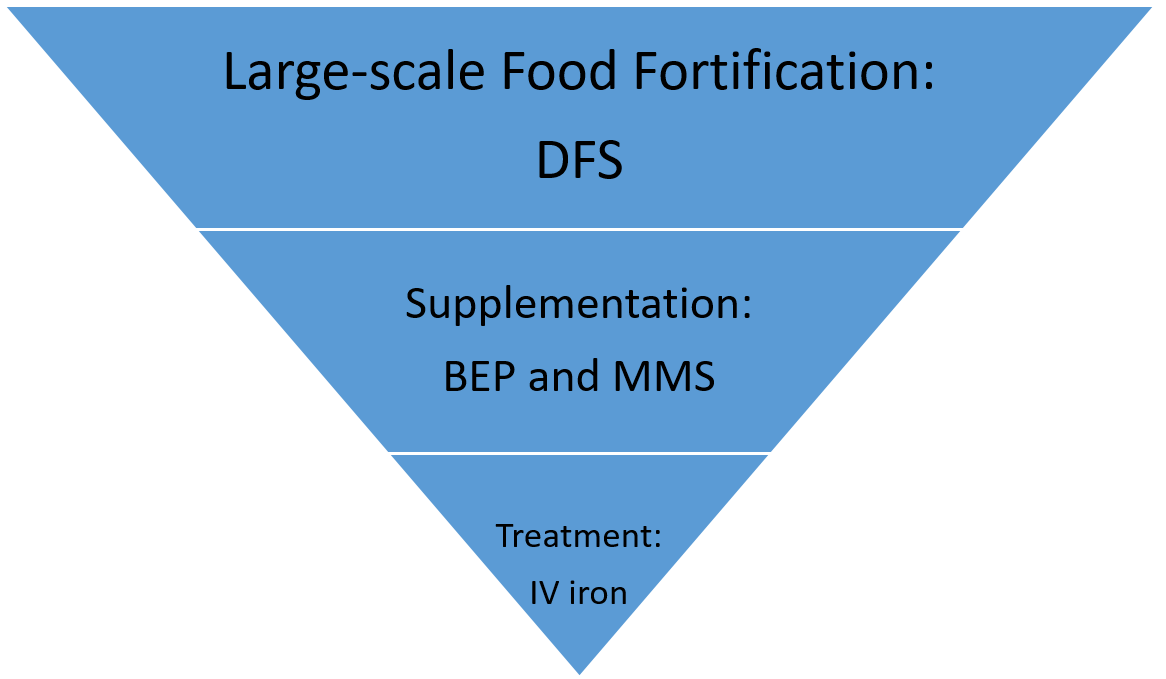
- The scope of our simulation work is to estimate following measures in 4 focal countries:
the size of eligible population at risk for each tier of the pyramid;
the burden of the maternal anemia in terms of deaths and DALYs occurring in the population at risk within each tier of the pyramid if we assume intervention is not applicable;
the impact at each tier on maternal anemia in terms of averted deaths and DALYs if we assume complete pyramid of interventions are applied.
Tier |
Intervention |
Product name |
Product definition |
Target population |
Note |
|---|---|---|---|---|---|
1 |
Large-scale food fortification |
DFS |
Women of reproductive age (15 to 49 years) |
||
2 |
Supplementation |
BEP |
PLW at ANC service with BMI less than 18.5 |
||
2 |
Supplementation |
MMS |
PLW at ANC service with BMI greater than or equal to 18.5 |
||
3 |
Treatment |
IV iron |
Pregnant women in 2nd/3rd trimester with moderate/severe anemia referred from ANC to higher level facility |
Todo
Fill out the table above with intervention product definition.
Outcome |
Effect |
Population |
Note |
|---|---|---|---|
Population mean hemoglobin |
Additive |
General population/PLW/anemic PLW |
LSFF/supplementation/treatment effect sizes and target populations vary. Hemoglobin shift affects both anemia and maternal mortality |
Baseline Coverage Data
Todo
Document intervention coverage for eligible population
Location |
Subpopulation |
Coverage parameter |
Value |
Note |
|---|---|---|---|---|
Bangladesh |
||||
Malawi |
||||
Nigeria |
||||
Pakistan |
Vivarium Modeling Strategy
Warning
This document summarizes the modeling strategy to calculate the impact of these interventions among PLW for a multiplication model. For the Vivarium microsimulation modeling strategy of the maternal supplementation strategy on maternal hemoglobin levels, see this document.
Hemoglobin
- How to model hemoglobin exposure in Vivarium:
Construct hemoglobin distributions for each location-/age-/population- subgroup
Apply pregnancy adjustment factor to hemoglobin distributions for pregnant and general populations
Modify hemoglobin distributions based on intervention effects
The hemoglobin model in GBD 2019 can be found Here.
Outcome |
Outcome type |
Outcome ID |
Affected measure |
Effect size measure |
Effect size |
Note |
|---|---|---|---|---|---|---|
Hemoglobin |
MEID |
10487 |
Mean hemoglobin concentration |
Risk difference |
Detailed in table Effect Size |
Restriction |
Value |
Note |
|---|---|---|
Male only |
False |
|
Female only |
True |
|
Age group start |
15 years (ID 8) |
|
Age group end |
49 years (ID 14) |
Note
Reproductive age is defined as 10 to 54 years in GBD, we trimmed it for this project by request of BMGF.
Intervention |
Effect size |
Relative to |
Effect size Label |
|---|---|---|---|
DFS |
3.3 (95%CI 1.8-4.8) |
No DFS intervention |
A |
MMS (or IFA) |
7.8 (95%CI 4.08-11.52) |
No iron in pregnancy |
B |
BEP |
3.7 (95%CI 1.9-5.6) |
IFA |
C |
IV iron |
23 (95%CI TBD) |
No IV iron intervention |
D |
Tier |
Addition to non-PLW population hemoglobin |
Addition to PLW population hemoglobin |
|---|---|---|
1 |
\(+ A\) |
\(+ A\) |
2 |
\(+ A\) |
\(+ A + P_{anc1} * [P_{underweight} * (P_{IFA} * C + (1 - P_{IFA}) * (B + C)) + (1 - P_{underweight}) * (1 - P_{IFA}) * B]\) |
3 |
\(+ A\) |
Average of \(+ A + P_{anc1} * [P_{underweight} * (P_{IFA} * C + (1 - P_{IFA}) * (B + C)) + (1 - P_{underweight}) * (1 - P_{IFA}) * B + P_{low\; hb} * D]\) and \(+ A + P_{anc1} * [(1 - P_{low\; hb}) * (P_{underweight} * (P_{IFA} * C + (1 - P_{IFA}) * (B + C)) + (1 - P_{underweight}) * (1 - P_{IFA}) * B) + P_{low\; hb} * D]\) |
- Where,
\(P_{anc1}\) = proportion of pregnant women have one time antenatal care visit within a year
\(P_{underweight}\) = proportion of pregnant women with BMI less than 18.5 kg/m^2
\(P_{IFA}\) = proportion of pregnant women have already received iron-folic acid
\(P_{low\; hb}\) = proportion of pregnant women with hemoglobin concentrations less than 100 g/L
Objective 1: Eligible population sizes
Population description |
Calculation |
|---|---|
Women of reproductive age (15 to 49 years) |
\(pop\) |
PLW at ANC |
\(pop * (asfr + sbr) * P_{anc1}\) |
Pregnant women in 2nd/3rd trimester with moderate/severe anemia referred from ANC to higher level facility |
\(pop * (asfr + sbr) * P_{anc1} * P_{low\; hb}\) |
- Where,
\(pop\) = GBD 2019 population size of female aged 15 to 49 years
\(P_{asfr}\) = GBD 2019 age-specific fertility rate, pulled using get_covariate_estimates with covariate_id = 13
\(P_{sbr}\) = GBD 2019 still birth rate (still birth to live birth ratio), pulled using get_covariate_estimates with covariate_id = 2267
\(P_{anc1}\) = proportion of pregnant women have one time antenatal care visit within a year, pulled using get_covariate_estimates with covariate_id = 7
\(P_{low\; hb}\) = proportion of pregnant women with hemoglobin concentrations less than 100 g/L
Objective 2: Anemia and Maternal Disorders Burden
Effects of hemoglobin on anemia and maternal disorders can be found here.