Chronic Kidney Disease (CKD): GBD 2019
Chronic kidney disease (CKD) is defined by NIH as kidneys that are damaged and can’t filter blood the way they should. The main risk factors for developing kidney disease are diabetes, high blood pressure, heart disease, and a family history of kidney failure. National Kidney Foundation (NKF) adds that CKD is also known as chronic renal disease. You may develop complications like high blood pressure, anemia (low blood count), weak bones, poor nutritional health and nerve damage. Also, kidney disease increases your risk of having heart and blood vessel disease. These problems may happen slowly over a long period of time. Early detection and treatment can often keep chronic kidney disease from getting worse. When kidney disease progresses, it may eventually lead to kidney failure, which requires dialysis or a kidney transplant to maintain life. [National-Institute-Of-Diabetes-And-Digestive-And-Kidney-Diseases-CKD-2019], [National-Kidney-Foundation-CKD-2019]
GBD 2019 Modeling Strategy
According to GBD 2019, Chronic kidney disease (CKD) is defined as a permanent loss of renal function as indicated by estimated glomerular filtration rate (eGFR) and urinary albumin to creatinine ratio (ACR). The GBD study considers six stages of CKD as defined by degree of loss of renal function or receipt of renal replacement therapy: CKD stages I & II (also known as Albuminuria) (eGFR > 60ml/min/1.73m2 and ACR > 30 mg/g), CKD Stage III (eGFR 30-60ml/min/1.73m2), CKD Stage IV (eGFR 15-30ml/min/1.73m2), CKD Stage V (eGFR <15ml/min/1.73m2, not on kidney replacement therapy), maintenance dialysis, and kidney transplantation.
The estimation strategy used for fatal chronic kidney disease is largely similar to methods used in GBD 2017. A standard CODEm model with location-level covariates was used to model deaths due to chronic kidney disease. In GBD 2019, the bias adjustment methods were improved by utilizing a MR-BRT model outside of DisMod to allow a more direct comparison between different case definitions and/or study designs. In GBD 2017, these adjustments were performed within DisMod.
Impaired Kidney Function (IKF) in GBD 2019
Impaired kidney function (IKF) is a risk factor in GBD 2019 with:
distribution of exposure data: categorical ordered polytomous model
rei_id_341
PAF of 1 relationship between IKF and CKD
Restriction Type |
Value |
Notes |
|---|---|---|
Male only |
False |
|
Female only |
False |
|
YLL only |
False |
|
YLD only |
False |
|
YLL age group start |
Post Neonatal |
(28, 364 days], age_group_id = 4 |
YLL age group end |
95 plus |
(95, 125], age_group_id = 235 |
YLD age group start |
Early Neonatal |
(0,6 days], age_group_id = 2 |
YLD age group end |
95 Plus |
(95, 125], age_group_id = 235 |
Category Name |
Description |
|---|---|
cat1 |
Stage V chronic kidney disease annual exposure |
cat2 |
Stage IV chronic kidney disease annual exposure |
cat3 |
Stage III chronic kidney disease annual exposure |
cat4 |
Albuminuria annual exposure |
cat5 |
Unexposed |
Cause Hierarchy
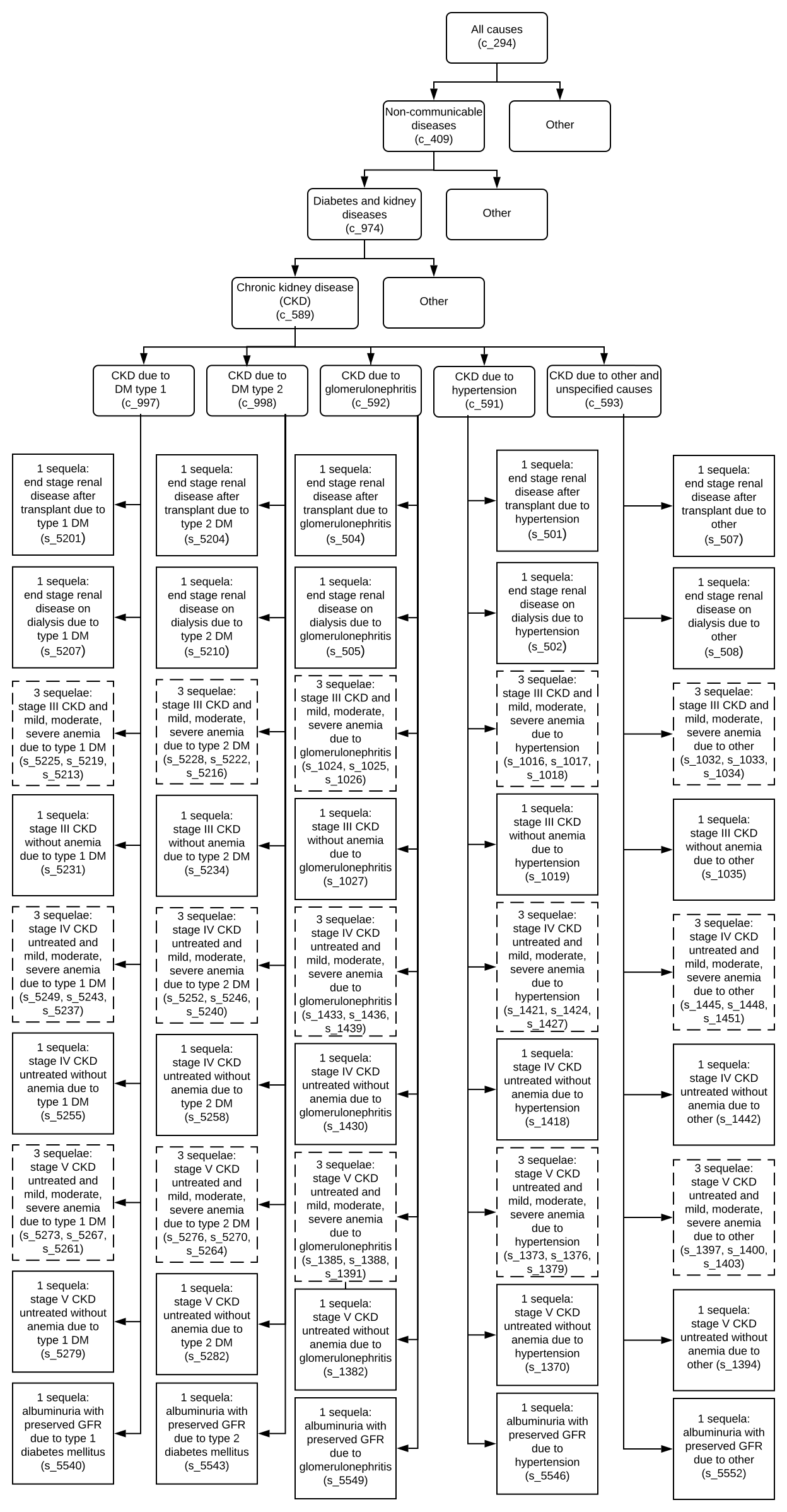
Restrictions
The following table describes any restrictions in GBD 2019 on the effects of this cause (such as being only fatal or only nonfatal), as well as restrictions on the ages and sexes to which the cause applies.
Restriction Type |
Value |
Notes |
|---|---|---|
Male only |
False |
|
Female only |
False |
|
YLL only |
False |
|
YLD only |
False |
|
YLL age group start |
Post Neonatal |
(28, 364 days], age_group_id = 4 |
YLL age group end |
95 plus |
(95, 125], age_group_id = 235 |
YLD age group start |
Early Neonatal |
(0,6 days], age_group_id = 2 |
YLD age group end |
95 Plus |
(95, 125], age_group_id = 235 |
Vivarium Modeling Strategy
Todo
Meet with RT if the cause model design should be replicated from GBD 2017 or if this will need to be adjusted, for the MM use case.
Scope
The aspects of the disease this cause model is designed to simulate is the basic structure of the disease, its sub causes, associated measures (deaths, prevalence, incidence, emr), associated sequelae, and associated disability weights. The aspects of the disease this cause model is not designed to simulate is the disease progression of CKD, as this model does not contain transitions between CKD states/stages. This cause model is designed differently, with a transient disease state titled ‘With Condition’ based on incidence of CKD. From there, the sub causes and sequelae are categorized within either a ‘moderate’ or ‘severe’ CKD state. Across the 5 CKD sub causes, some of the associated sequelae will either be grouped into the ‘Moderate’ or ‘Severe’ CKD state. The sequelae which map to ‘Severe’ CKD state include end stage renal disease sequelae and all Stage V CKD sequelae. All other sequelae are included in the ‘Moderate’ CKD. The associated sequelae in each state can be found below in the ‘State Severity Split Definitions’ table.
Vivarium Modeling Strategy for Risk Factor Impaired Kidney Function (IKF)
Initialization: - In this model, simulants are initialized as “susceptible” or “with specific sequelae-level condition” through the following process: simulants will be assigned directly to a CKD sequelae (“with condition” state) based on each sequelae prevalence. Those not assigned to a sequelae will be initialized to the “susceptible” state. Each sequelae will then be mapped back to the distribution of IKF based on sequelae based severity splits. The result will be an IKF value for each simulant that is consistent with sub-cause prevalence.
Progress: -As simulants age, their risk exposure will change, which may result in them progressing into a different disease state over time. Also, simulants will experience mortality based on their risk exposure.
Mapping CKD States to IKF Categories in Vivarium
Disease State |
Sequelae Group |
IKF Risk Exposure Category |
Sequelae Group Id |
Notes |
|---|---|---|---|---|
Moderate CKD |
albuminuria (stage I and II) sequelae |
cat4 |
[s_5540, s_5543, s_5549, s_5546, s_5552] |
All Albuminuria sequelae values due to CKD sub_causes |
Moderate CKD |
stage III sequelae |
cat3 |
[s_5225, s_5219, s_5213, s_5228, s_5222, s_5216, s_1024, s_1025, s_1026, s_1016, s_1017, s_1018, s_1032, s_1033, s_1034, s_5231, s_5234, s_1027, s_1019, s_1035] |
All Stage III sequelae values due to CKD sub_causes |
Moderate CKD |
stage IV sequelae |
cat2 |
[s_5249, s_5243, s_5237, s_5252, s_5246, s_5240, s_1433, s_1436, s_1439, s_1421, s_1424, s_1427, s_1445, s_1448, s_1451, s_5255, s_5258, s_1430, s_1418, s_1442] |
All Stage IV sequelae values due to CKD sub_causes |
Severe CKD |
stage V sequelae |
cat1 |
[s_5273, s_5267, s_5261, s_5276, s_5270, s_5264, s_1385, s_1388, s_1391, s_1373, s_1376, s_1379, s_1397, s_1400, s_1403, s_5279, s_5282, s_1382, s_1370, s_1394] |
All Stage V sequelae values due to CKD sub_causes |
Assumptions and Limitations
Assumptions
Presently, we are using prevalence for each stage of CKD to assign the each person in the population a CKD severity state. We are assuming (for now) that there is no transition between states. As a result, we should expect the prevalence for early stage CKD to swell as the simulation runs, since there is nowhere for these new incident cases to go. Transition rates (progression rates) between states are not available from the GBD model. As such, we are using evolution of risk exposure over time (changes with simulant age) to proxy for progression between CKD states - as a simulant ages, they may move to a different part of the IDF distribution, thereby landing them in a more advanced CKD state. The reason we are modeling CKD this way is because it is a condition for treatment of LDL-C, which is the intervention in this model. Thus, we need to get the prevalence at each severity (mild/moderate v. severe) correct. CKD is not a cause of interest in the current project it is being modeled in, so the severity specific prevalence is the current priority.
Simulants are in each disease state longer than they should be, compared to GBD 2017.
This model assumes there is no impact of SBP nor FPG on CKD.
Limitations
This model is consistent with prevalence in population. The following relationships between CKD/SBP and CKD/FPG will be modeled using correlation. The iniitial distribution will be correct, but will change over time and become inaccurate due to mitigating factors.
Cause Model Diagram
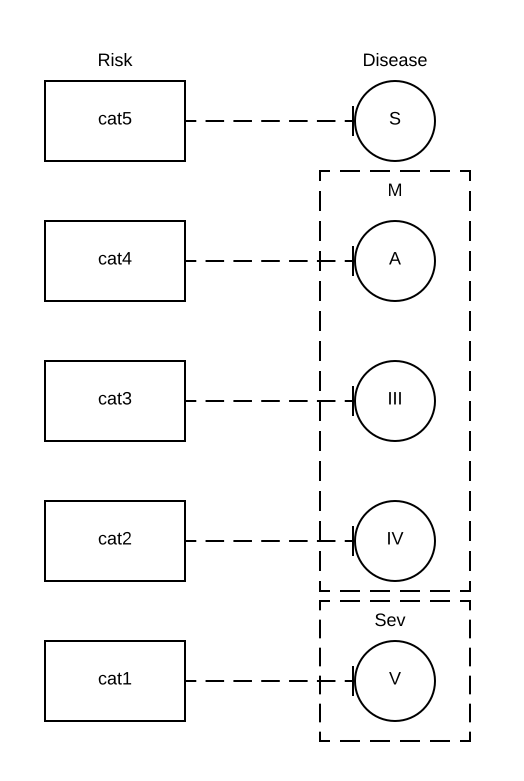
Data Description
State and Transition Data Tables
State |
State Name |
Definition |
|---|---|---|
S |
Susceptible |
Susceptible to CKD |
C |
With Condition of chronic kidney disease |
Has CKD, regardless of moderate or severe CKD |
M |
Moderate CKD |
Has moderate CKD (not severe, not fatal) |
Sev |
Severe CKD |
Has severe CKD (fatal) |
State |
State Name |
Definition |
|---|---|---|
S |
Susceptible |
|
C |
With Condition of chronic kidney disease |
|
M |
Moderate CKD |
sequelae_mod = [s_5225, s_5219, 5213, s_5231, s_5249, s_5243, s_5237, s_5255, s_5540, s_5228, s_5222, s_5216, s_5234, s_5252, s_5246, s_5240, s_5258, s_5543, s_1024, s_1025, s_1026, s_1027, s_1433, s_1436, s_1439, s_1430, s_5549, s_1016, s_1017, s_1018, s_1019, s_1421, s_1424, s_1427, s_1418, s_5546, s_1032, s_1033, s_1034, s_1035, s_1445, s_1448, s_1451, s_1442, s_5552] |
Sev |
Severe CKD |
sequelae_sev = [s_5201, s_5207, s_5273, s_5267, s_5261, s_5279, s_5204, s_5210, s_5276, s_5270, s_5264, s_5282, s_504, s_505, s_1385, s_1388, s_1391, s_1382, s_501, s_502, s_1373, s_1376, s_1379, s_1370, s_507, s_508, s_1397, s_1400, s_1403, s_1394] |
State |
Measure |
Value |
Notes |
|---|---|---|---|
S |
simulants not prevalent with CKD |
1-prevalence_c589 |
|
M |
prevalence |
\({\sum_{s\in \text{prevalence\_sequelae\_mod.sub\_causes.c589}}}\) |
= prevalence of Albuminuria sequelae + CKD stage III sequelae + CKD stage IV sequelae |
Sev |
prevalence |
\({\sum_{s\in \text{prevalence\_sequelae\_sev.sub\_causes.c589}}}\) |
= prevalence of CKD stage V sequelae + CKD end stage sequelae |
cat1 |
excess mortality rate (EMR) of cat1 |
\(\frac{\text{CSMR*\_c589}}{\text{prevalencec589}}\) |
= CSMR (* indicates calculated below) of CKD / prevalence of CKD |
cat2 |
excess mortality rate (EMR) of cat2 |
\(\frac{\text{CSMR*\_c589}}{\text{prevalencec589}}\) |
= CSMR (* indicates calculated below) of CKD / prevalence of CKD |
cat3 |
excess mortality rate (EMR) of cat3 |
\(\frac{\text{CSMR*\_c589}}{\text{prevalencec589}}\) |
= CSMR (* indicates calculated below) of CKD / prevalence of CKD |
cat4 |
excess mortality rate (EMR) of cat4 |
\(\frac{\text{CSMR*\_c589}}{\text{prevalencec589}}\) |
= CSMR (* indicates calculated below) of CKD / prevalence of CKD |
cat5 |
excess mortality rate (EMR) of cat4 |
0 |
this equals 0 because the disease state mapped to this is ‘susceptible’ |
M |
excess mortality rate (EMR) of moderate CKD |
\(\frac{\text{CSMR*\_c589}}{\text{prevalencec589}}\) |
= CSMR (* indicates calculated below) of CKD / prevalence of CKD |
cat1 |
disability weight |
\(\frac{{\sum_{sequelae\in \text{cat1}}} \scriptstyle{\text{disability\_weight}_s \times\ \text{prevalence}_s}}{{\sum_{sequelae\in \text{cat1}} \scriptstyle{\text{prevalence}_s}}}\) |
disability weight for IKF cat1 (sequelae mapped to IKF cat1) |
cat2 |
disability weight |
\(\frac{{\sum_{sequelae\in \text{cat2}}} \scriptstyle{\text{disability\_weight}_s \times\ \text{prevalence}_s}}{{\sum_{sequelae\in \text{cat2}} \scriptstyle{\text{prevalence}_s}}}\) |
disability weight for IKF cat2 (sequelae mapped to IKF cat2) |
cat3 |
disability weight |
\(\frac{{\sum_{sequelae\in \text{cat3}}} \scriptstyle{\text{disability\_weight}_s \times\ \text{prevalence}_s}}{{\sum_{sequelae\in \text{cat3}} \scriptstyle{\text{prevalence}_s}}}\) |
disability weight for IKF cat3 (sequelae mapped to IKF cat3) |
cat4 |
disability weight |
\(\frac{{\sum_{sequelae\in \text{cat4}}} \scriptstyle{\text{disability\_weight}_s \times\ \text{prevalence}_s}}{{\sum_{sequelae\in \text{cat4}} \scriptstyle{\text{prevalence}_s}}}\) |
disability weight for IKF cat4 (sequelae mapped to IKF cat4) |
cat5 |
disability weight |
0 |
this equals 0 because the disease state mapped to this is ‘susceptible’ |
All |
cause-specific mortality rate |
\(\frac{\text{deaths\_c589}}{\text{population}}\) |
calculated CSMR, not a direct input from GBD 2017 |
Variable |
Source |
Description |
Notes |
|---|---|---|---|
prevalence_c589 |
como |
prevalence of chronic kidney disease |
|
deaths_c589 |
codcorrect |
Count of deaths due to chronic kidney disease |
|
population |
demography |
Mid-year population for given sex/age/year/location |
|
prevalence_s{sid} |
como |
Prevalence of sequela with id {id} |
|
disability_weight_s{sid} |
YLD appendix |
Disability weight of sequela with id {id} |
|
risk_exposure_rei_id_341 |
exposure |
risk exposure of IKF |
|
relative_risk_rei_id_341 |
exposure |
relative risk of IKF and affected causes |
|
paf_rei_id_341 |
burdenator |
PAF of IKF |
Validation Criteria
Todo
Add Validation Criteria
References
Retrieved 7 Feb 2020. https://www.niddk.nih.gov/health-information/kidney-disease/chronic-kidney-disease-ckd
Retrieved 7 Feb 2020. https://www.kidney.org/atoz/content/about-chronic-kidney-disease