Ischemic Heart Disease: GBD 2017
Disease Description
Ischemic heart disease (IHD) is a non-communicable cardiovascular disease which occurs when the arteries of the heart cannot deliver enough oxygen-rich blood to the heart. Since 1990, this disease has been a leading cause of global Years of Life Lost (YLL). GBD 2017 listed IHD as the leading cause of YLLs globally, with a mean percentage increase in 3.9% in all-age YLL rate since 2007. According to NIH, IHD is also known as Coronary Artery Disease, Coronary Heart Disease, Coronary Microvascular Disease. Symptoms and complications can vary by person, even if they have the same type of ischemic heart disease. Reported symptoms vary whether a person is experiencing an acute coronary event, such as a heart attack, or has chronic IHD. Symptoms may get worse as the buildup of plague continues to narrow the coronary arteries.
Acute coronary events may cause symptoms such as angina, cold sweats, dizziness, nausea, neck pain, shortness of breath, sleep disturbances, or weakness.
Chronic ischemic heart disease can cause signs and symptoms such as angina, anxiety or nervousness, fatigue, or neck pain.
GBD 2017 Modeling Strategy
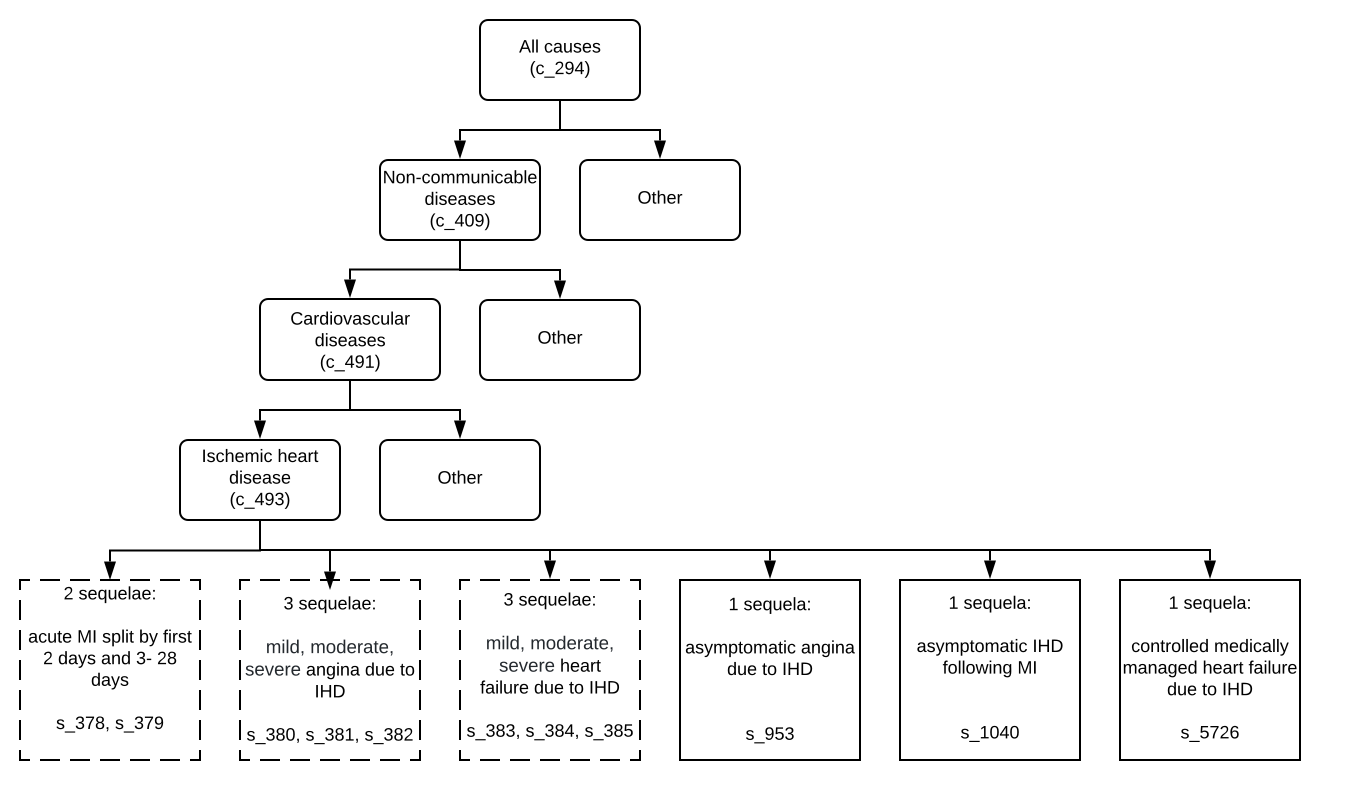
GBD 2017 models fatal and non-fatal IHD estimates separately. GBD 2017 models IHD using Myocardial infarction (MI) sequelae to estimate the prevalence of IHD, due to the challenges of disease detection and varying symptoms across the population.
Myocardial infarction (MI) in GBD 2017
The case definition can be found below and is stratified by two sections: ‘Acute myocardial infarction (MI)’ and ‘Chronic IHD’. The case definition for non-fatal IHD modeling can be found in both sections of the case definition. The case definition for fatal IHD modeling can be found in section 1 below.
Acute myocardial infarction (MI): Definite and possible MI according to the third universal definition of myocardial infarction:
When there is clinical evidence of myocardial necrosis in a clinical setting consistent with myocardial ischemia or detection of a rise and/or fall of cardiac biomarker values and with at least one of the following:
symptoms of ischemia,
new or presumed new ST-segment-T wave changes or new left bundle branch block,
development of pathological Q waves in the 277 ECG,
imaging evidence of new loss of viable myocardium or new regional wall motion abnormality, or
identification of an intracoronary thrombus by angiography or autopsy.
Sudden (abrupt) unexplained cardiac death, involving cardiac arrest or no evidence of a noncoronary cause of death.
Prevalent MI is considered to last from the onset of the event to 28 days after the event and is divided into an acute phase (0–2 days) and subacute (3–28 days).
Chronic IHD
Angina; clinically diagnosed stable exertional angina pectoris or definite angina pectoris according to the Rose Angina Questionnaire, physician diagnosis, or taking nitrate medication for the relief of chest pain.
Asymptomatic ischemic heart disease following myocardial infarction; survival to 28 days following incident MI. The GBD study does not use estimates based on ECG evidence for prior MI, due to its limited specificity and sensitivity.
For GBD 2017 IHD fatal model, the type of model input data included data from vital registration and verbal autopsy data. The fatal model outliered verbal autopsy data in countries and subnational locations where high-quality vital registration data were also available. The fatal model also outliered non-representative subnational verbal autopsy data points, ICD8 and ICD9 BTL data points which were inconsistent with the rest of the data and created implausible time trends, and data in a number of Indian states identified by experts as poor-quality. For the fatal model, estimates for YLLs were calculated by pulling CoD data and location-level covariates, running this data through CODEm models and CodCorrect, and adjusting for deaths at the location/year/age/sex stratification. [GBD-2017-YLL-Capstone-Appendix-1-Ischemic-Heart-Disease]
For GBD 2017 IHD non-fatal model, the type of model input data included epi data from a systematic review, vital registration, and verbal autopsy data. For the non-fatal model, the proportion of MI is calculated by pulling in CoD data and pre-redistribution of CoDCorrect data and loading into Dismod. Acute IHD CSMR is calculated through a custom process which includes post-CodCorrect IHD deaths. MI prevalence and incidence results are estimated through standard Dismod model. MI prevalence estimates are then used to calculate severity splits of acute MI and chronic IHD. Asymptomatic IHD prevalence is estimated through pulling data from Dismod and then making adjustments to avoid double-counting heart failure due to IHD and Angina due to IHD. Angina due to IHD is estimated using a standard Dismod model. These estimates are then used for severity splits of angina due to IHD. YLLS, DALYs, and comorbidity-adjusted YLDs are estimated by pulling in all unadjusted results of prevalence and incidence (MI, acute IHD, IHD following MI, angina due to IHD) and weighing for disability. [GBD-2017-YLD-Capstone-Appendix-1-Ischemic-Heart-Disease]
Cause Hierarchy
Restrictions
The following table describes any restrictions in GBD 2017 on the effects of this cause (such as being only fatal or only nonfatal), as well as restrictions on the ages and sexes to which the cause applies.
Restriction Type |
Value |
Notes |
|---|---|---|
Male only |
False |
|
Female only |
False |
|
YLL only |
False |
|
YLD only |
False |
|
YLL age group start |
15 |
[15, 20), age_group_id=8 |
YLL age group end |
125 |
[95, 125 years), age_group_id=235 |
YLD age group start |
15 |
[15, 20), age_group_id=8 |
YLD age group end |
125 |
[95, 125 years), age_group_id=235 |
Vivarium Modeling Strategy
Scope
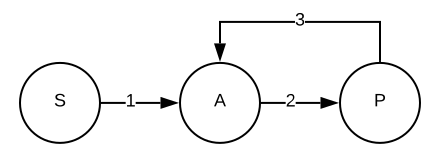
The aspects of the disease this cause model is designed to simulate are the states, transitions, and sequelae. The Vivarium model of IHD has been of a similar design to GBD 2017 by modeling IHD using MI sequelae to estimate the prevalence of IHD. Like GBD 2017, Vivarium’s design includes two states: one that is defined by myocardial infarction (‘Acute MI’) and one state defined by a chronic state that is duration-based (‘Post-MI’). Vivarium’s design of ‘Acute MI’ is modeled exactly after GBD 2017’s ‘Acute MI’ case definition. Vivarium’s design of ‘Post MI’ is modeled exactly after GBD 2017’s ‘Chronic IHD’ case definition.
Model Assumptions and Limitations
Apart from inpatient hospital and inpatient claims data, GBD 2017 did not include any data from sources other than the literature for myocardial infarction. Given this information, the assumption is that MI is the best and only estimator for the IHD model. The limitation of this assumption and approach is the exclusion of non-MI data sources could be underestimating the IHD model. In the Vivarium Modeling Strategy, the limitation of the IHD model is we do not initial ‘Acute MI’ state in the first 28 days, and assume that prevalence = 0.
The risk factor of SBP affects the transition rates 1 and 3 listed below, through the GBD measure of incidence_c493.
Cause Model Diagram
Data Description
State and Transition Data Tables
State |
State Name |
Definition |
|---|---|---|
S |
Susceptible |
Susceptible to IHD |
A |
Acute Myocardial Infarction (MI) |
Simulant that experiences acute MI symptoms |
P |
Post-MI IHD |
Simulant that experiences angina and asymptomatic ischemic heart disease following myocardial infarction; survival to 28 days following incident MI |
State |
Measure |
Value |
Notes |
|---|---|---|---|
All |
cause-specific mortality rate |
\(\frac{\text{deaths\_c493}}{\text{population}}\) |
|
P |
excess mortality rate |
emr_m15755 |
|
A |
excess mortality rate |
emr_m1814 |
|
S |
excess mortality rate |
0 |
|
P |
disability weight |
\(\frac{1}{\text{prevalence\_c493}} \times \sum\limits_{s \in post-mi-sequelae} \text{disability\_weight}_s \cdot \text{prevalence}_s\) |
|
A |
disability weight |
\(\frac{1}{\text{prevalence\_c493}} \times \sum\limits_{s\in acute-sequelae} \text{disability\_weight}_s \cdot \text{prevalence}_s\) |
|
S |
disability weight |
0 |
|
P |
prevalence |
\(\sum\limits_{s\in post-mi-sequelae} \text{prevalence}_s\) |
|
A |
prevalence |
\(\sum\limits_{s\in acute-sequelae} \text{prevalence}_s\) |
|
S |
prevalence |
1-prevalence_493 |
simulants not prevalent with IHD |
Transition |
Source State |
Sink State |
Value |
Notes |
|---|---|---|---|---|
1 |
S |
A |
incidence_c493 |
|
2 |
A |
P |
28 days |
duration-based transition from acute state then progress into post state |
3 |
P |
A |
incidence_493 |
Variable |
Source |
Description |
Notes |
|---|---|---|---|
prevalence_c493 |
como |
prevalence of ischemic heart disease |
|
deaths_c493 |
codcorrect |
Count of deaths due to chronic kidney disease |
|
population |
demography |
Mid-year population for given sex/age/year/location |
|
prevalence_s{sid} |
como |
Prevalence of sequela with id {id} |
|
disability_weight_s{sid} |
YLD appendix |
Disability weight of sequela with id {id} |
|
incidence_493 |
como |
Incidence of ischemic heart disease |
|
emr_m15755 |
dismod-mr |
excess-mortality rate of post-MI ischemic heart disease |
|
emr_m1814 |
dismod-mr |
excess-mortality rate of MI due to ischemic heart disease |
|
acute-sequelae |
model assumption |
{s378, s379} |
|
post-mi-sequelae |
model assumption |
{s380, s381, s382, s383, s384, s385, s953, s1040, s5726} |
Validation Criteria
Todo
Describe tests for model validation.
At the IHD cause level:
Is CSMR close to pre
References
Supplement to: GBD 2017 Disease and Injury Incidence and Prevalence Collaborators. Global, regional, and national incidence, prevalence, and years lived with disability for 354 diseases and injuries for 195 countries and territories, 1990–2017: a systematic analysis for the Global Burden of Disease Study 2017. Lancet 2018; 392: 1789–858 (pp. 335-341)
Supplement to: GBD 2017 Causes of Death Collaborators. Global, regional, and national age-sex-specific mortality for 282 causes of death in 195 countries and territories, 1980–2017: a systematic analysis for the Global Burden of Disease Study 2017. Lancet 2018; 392: 1736–88 (pp. 203-204)